Amazon Best Sellers Rank appears on millions of product pages, but the number is easy to misinterpret. A product ranked #5,000 may be selling regularly, while the same rank in another category may reflect a very different level of demand.
For Amazon sellers, BSR provides a way to put a product’s sales activity into context. It can be useful when comparing products or looking at demand, provided that the ranking is considered alongside its category, marketplace and sales history.
Understanding what Amazon BSR measures, and where its limitations lie, can help you make better use of it when analysing online arbitrage opportunities.
What is Amazon BSR?
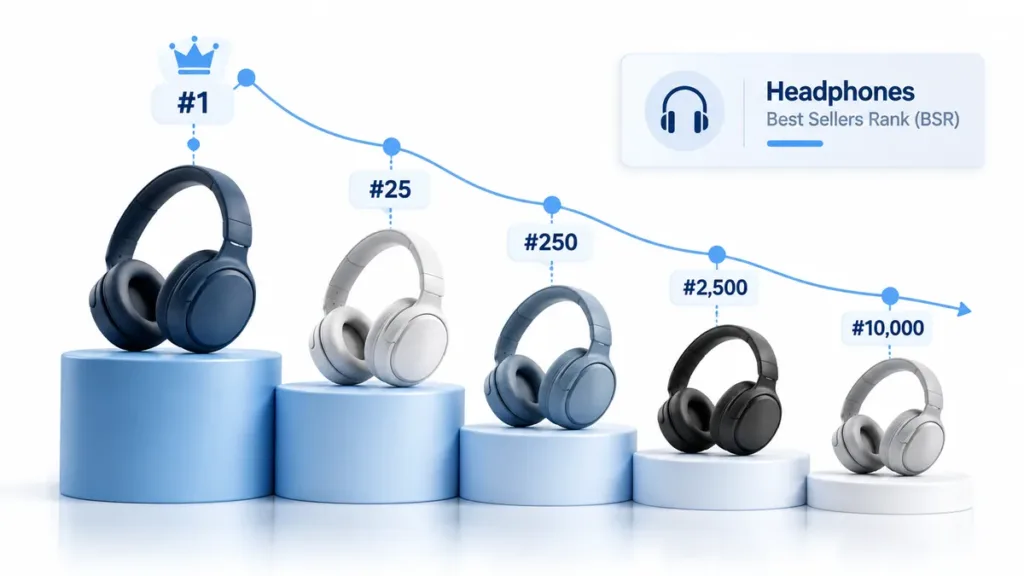
Amazon BSR stands for Best Sellers Rank. It ranks a product according to its sales performance relative to other products in the same Amazon category.
A lower number represents a higher position. For example, a product with a BSR of #200 ranks above one at #20,000 within the same category.
Amazon calculates BSR using sales data. Both recent and historical sales contribute to the ranking, although recent sales carry more weight. Page views and customer reviews do not directly determine BSR.
The same product can have more than one ranking if it appears in several categories or subcategories. This is why a BSR number without its category provides limited information.
You may also encounter the term sales rank, particularly in product research tools and historical charts. It is commonly used when referring to BSR data.
BSR is different from Amazon search ranking. Best Sellers Rank reflects sales performance within a category, while search ranking refers to a listing’s position for a particular search query. A product can therefore perform strongly within its category without appearing at the top of the organic results for every relevant keyword.
How does Amazon Best Sellers Rank work?
Amazon does not disclose the exact formula behind BSR. It does state that sales volume is used to calculate the ranking and that recent sales have greater influence than older ones.
As sales occur, the product’s position can change in relation to other products in its category. BSR is therefore dynamic rather than a fixed measure of demand.
This relative nature of the ranking is important. The same BSR number does not necessarily represent the same level of sales across different categories. A rank of #10,000 in a large, active category may have a different meaning from #10,000 in a smaller one.
The marketplace also matters. Amazon calculates Best Sellers Rank separately across its stores, so a product can occupy different positions on Amazon UK, Germany, France or other marketplaces.
For sellers working across Europe, the relevant BSR is therefore the one for the marketplace where the product is being analysed.
Where can you find a product’s BSR on Amazon?
A product’s Best Sellers Rank can usually be found in the Product information or Product details section of its Amazon product page, depending on the marketplace and page layout.
Some ASINs display several rankings because the product is listed in more than one category or subcategory. When analysing the number, check which category each ranking refers to rather than treating the values as interchangeable.
Product research tools can also provide BSR data. Their main advantage for analysis is that some of them retain historical information, allowing you to see how the rank has changed rather than relying on the value displayed on Amazon at a particular moment.
What is a good BSR on Amazon?
There is no universal BSR threshold that defines a good product. A rank needs to be interpreted within its category and marketplace. For this reason, rules such as buying only products below a particular BSR can be misleading when applied across different categories.
Imagine two products with a BSR of #15,000. One belongs to a category with very high sales activity, while the other sits in a much smaller category. Their identical rankings do not mean that they sell the same number of units.
The amount of demand you need also depends on the deal you are considering. A seller testing three units does not have the same exposure as one purchasing 50. In both cases the BSR may be identical, but the level of sales needed to move the stock is different.
Rather than looking for a single good BSR, use the ranking to understand where the product sits within its particular market.
What does BSR tell you about sales?
BSR provides information about relative sales performance, but it does not reveal the exact number of units sold.
In general, a lower BSR indicates stronger sales performance relative to other products in the same category. This relationship is one reason product research tools use BSR, together with data such as category and marketplace, when estimating sales.
Those estimates should not be confused with actual unit sales. There is no universal conversion such as “BSR #5,000 equals X units per month”.
This becomes particularly important when considering sales velocity, or the rate at which a product sells over a period of time. BSR can provide evidence of sales activity, but it cannot tell an individual seller how many of those sales they are likely to receive.
A listing may sell frequently while having several FBA sellers competing for the Buy Box. The demand for the ASIN can therefore be strong even though each seller receives only a portion of the total sales.
Why BSR history matters more than a single ranking
Consider a product currently sitting at BSR #8,000. The number shows its position now, but it does not tell you whether that position is typical.
If the product normally fluctuates around #8,000 to #12,000, its current ranking fits its recent pattern. If it normally sits around #70,000, the same #8,000 ranking may reflect a temporary increase in sales.
Sales rank history adds this missing context. Looking at changes over time can help you identify relatively stable demand, periods of stronger or weaker sales and patterns associated with seasonality. It also reduces the risk of basing a purchasing decision on an unusual snapshot.
Keepa is commonly used for this type of analysis because its charts include historical sales rank alongside other product data. Actorio’s guide to using Keepa for Amazon FBA product sourcing explains how to read these graphs in more detail.
The purpose is not to find a perfectly stable BSR. Rankings naturally move. What matters is understanding whether the current number is broadly consistent with the product’s previous sales activity or represents an exception.
How to use BSR when analysing online arbitrage products
For an online arbitrage seller, BSR can help answer an initial question: is there evidence that this product is selling in the marketplace you are analysing?
Start with the category attached to the ranking and then look at the product’s historical sales rank. A current BSR becomes more informative when you can see whether similar levels have been maintained over time.
Historical patterns can also make comparisons between potential deals more useful. Two products may have similar BSR values today, while their histories tell different stories. One may show fairly regular sales activity; the other may have reached its current position after a short-lived increase in demand.
Competition on the listing adds another layer. BSR relates to the product’s overall sales performance, not to the number of sales that a particular seller will receive. Seller count and Buy Box competition therefore matter when estimating your own likely sales.
Nor does a strong BSR make a deal profitable. Purchase cost, Amazon fees, VAT, selling price and other expenses still determine whether there is enough return to justify the purchase. The guide to assessing product profitability on Amazon covers that part of the analysis separately.
Quantity matters as well. If sales data appears sufficient for a small test purchase, that does not automatically mean the same product can support a much larger order. The article on Amazon FBA inventory management looks more closely at expected sales, purchasing quantities and capital exposure.
BSR is therefore most useful as one source of evidence within a broader product analysis. It helps describe demand, while other data tells you about competition, profitability and the level of inventory that makes sense for the deal.
Actorio brings supplier catalogues and Amazon marketplace data together to help European online arbitrage sellers analyse potential products more efficiently.
Frequently asked questions about Amazon BSR
What does BSR stand for on Amazon?
BSR stands for Best Sellers Rank. It shows a product’s sales position relative to other products within an Amazon category.
Is a lower Amazon BSR better?
A lower BSR represents a higher position within the relevant category. A product ranked #500 is therefore above one ranked #5,000 in that category. This does not mean that the same BSR represents identical sales across different categories or marketplaces.
How is Amazon BSR calculated?
Amazon says that BSR is based on sales volume data, with both recent and historical sales contributing to the calculation. Recent sales receive greater weight. Amazon does not disclose the exact formula used to produce the ranking.
Does BSR show how many units a product sells?
No. BSR is a relative ranking rather than an exact sales figure. It can be used as an input for sales estimates, but the ranking itself does not reveal how many units have been sold.