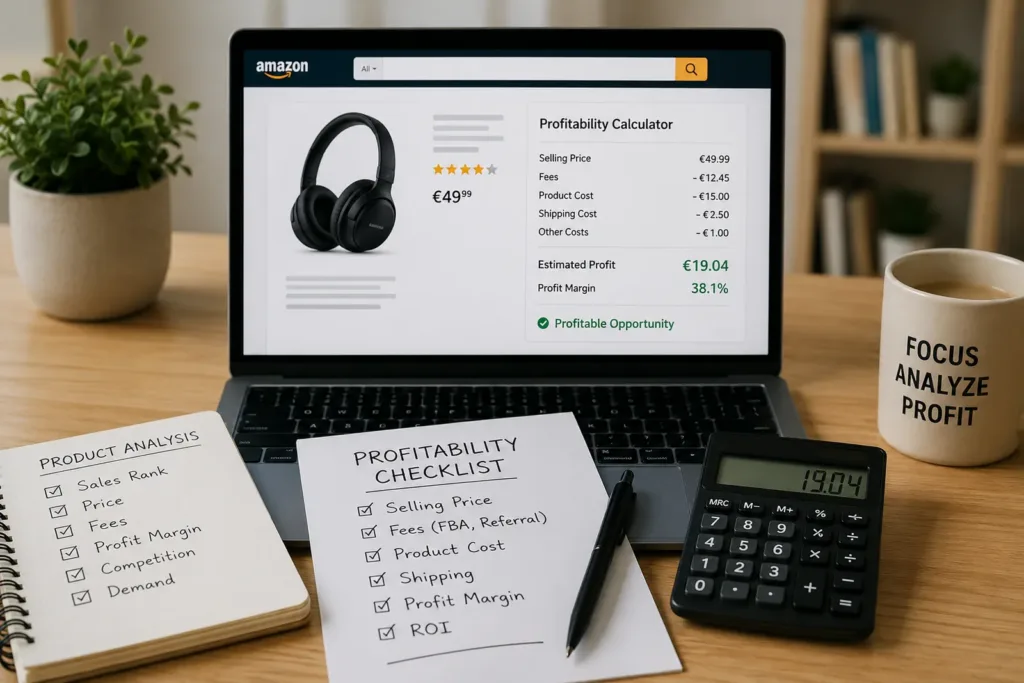
Knowing how to assess product profitability for Amazon FBA requires more than comparing a supplier’s price with the current Amazon selling price. That initial difference can look attractive, but it does not show how much money you will actually make.
Amazon fees, VAT, shipping, product preparation and price fluctuations can turn an apparently profitable deal into a poor investment. A proper assessment brings these costs together and considers whether the product is likely to sell at the price used in your calculation.
Start with accurate product and supplier data
Profitability calculations depend on the quality of the information you use. An incorrect ASIN (Amazon Standard Identification Number), an outdated supplier price or a mismatch between product variations can invalidate the result before you begin.
Check the following information for each product:
- Supplier price and VAT status
- Pack size and number of units included
- Minimum order quantity
- Shipping and preparation costs
- Correct ASIN and product variation
- Current and historical Buy Box prices
- Estimated Amazon fees
- Recent sales performance
Pay particular attention to multipacks, sizes, colours and model numbers. A supplier may sell a pack of two while the Amazon listing refers to an individual item, or vice versa.
If you are still looking for suitable products, this guide to finding profitable products to resell on Amazon provides a more structured approach to the sourcing process.
How to calculate Amazon FBA profit
The difference between the purchase price and the Amazon selling price is the gross spread. Your estimated profit is the amount left after deducting the costs involved in getting the product sold.
A simplified formula is:
Estimated profit = selling price − product cost − Amazon fees − shipping and preparation costs − applicable taxes
Suppose a product costs €20 from the supplier and currently sells for €39.99 on Amazon. The sale may also involve:
- €6.50 in Amazon fees
- €1.50 in shipping and preparation costs
Before any additional VAT adjustments, the calculation would be:
€39.99 − €20 − €6.50 − €1.50 = €11.99 estimated profit
This figure is a starting point. The actual profit could be lower if the selling price falls, storage costs increase or some units are returned.
Costs to include in your profitability calculation
Supplier price
Use the amount you will actually pay rather than the headline price shown in the supplier catalogue. Confirm whether VAT is included and whether the advertised price depends on purchasing a minimum quantity.
Volume discounts can improve the return per unit, although a larger order also increases the amount of capital at risk. The discount only benefits the business if the stock sells within a reasonable period.
Amazon fees
Amazon charges vary according to the marketplace, product category, dimensions, weight and fulfilment method. For an FBA product, relevant charges may include:
- Referral fees
- FBA fulfilment fees
- Monthly storage fees
- Aged inventory charges
- Removal or disposal fees
The calculation should use the fees associated with the exact ASIN whenever possible. Two similar products can incur different fulfilment costs if their packaged dimensions or categories are different.
Fees may also change, so they should be checked again before placing a substantial order.
Shipping and product preparation
Include the cost of transporting the goods from the supplier and sending them to an Amazon fulfilment centre. The calculation should also cover any required labelling, repackaging, inspection or preparation services.
These expenses can appear insignificant when viewed separately. Across a larger order, however, even a small additional cost per unit can noticeably reduce the overall return.
VAT and other taxes
VAT affects supplier costs, selling prices and the amount retained after a sale. Its treatment depends on factors such as the marketplace, the supplier’s location and the seller’s tax situation.
For an initial comparison, make sure all figures use the same VAT basis. Comparing a wholesale price excluding VAT with an Amazon price including VAT will produce a misleading margin unless the appropriate adjustment is made.
Tax circumstances vary between businesses and European marketplaces. When necessary, confirm the calculation with a qualified tax adviser.
Returns and unsold inventory
A profitability estimate based on a successful sale does not account for every possible outcome. Returns, damaged goods and stock that remains in storage can reduce the final result.
The level of risk varies by category. Clothing and footwear, for example, may experience different return patterns from household consumables. Previous sales data can help you decide whether to include a contingency cost in your calculations.
Calculate ROI and profit margin
Estimated profit tells you how much a unit could generate. ROI and profit margin help you judge whether that return is worthwhile in relation to the money invested and the final selling price.
Return on investment
Return on investment (ROI) measures the estimated profit against the cost of purchasing the product:
ROI = estimated profit ÷ product cost × 100
Using the previous example:
€11.99 ÷ €20 × 100 = 59.95% ROI
ROI is useful when comparing products that require different levels of investment. A product can produce more profit per sale while offering a lower return on the capital used to buy it.
Some sellers calculate ROI using only the product cost, while others include additional expenses in the investment figure. Whichever method you choose, apply it consistently when comparing opportunities.
Profit margin
Profit margin compares the estimated profit with the selling price:
Profit margin = estimated profit ÷ selling price × 100
For the same product:
€11.99 ÷ €39.99 × 100 = 29.98% profit margin
There is no single minimum ROI or margin that works for every Amazon FBA seller. Appropriate targets depend on available capital, operating expenses, expected sales volume and tolerance for risk.
Check whether demand is sustainable
A strong margin has limited value if the product rarely sells. Review sales estimates, sales rank history and seasonal patterns to determine whether recent demand is likely to continue.
A product with regular sales over several months generally provides a more reliable basis for planning inventory than one experiencing a brief surge. That surge could come from a promotion, a social media trend or a seasonal event.
Consider how long it may take to sell the proposed order quantity. Slow-moving inventory ties up capital and may generate additional storage fees. If a supplier requires an order of 200 units but the listing records only modest monthly sales, the attractive unit price may not justify the commitment.
Seasonal products require a different assessment. Their sales history should be compared with the same period in previous years rather than with the immediately preceding months.
Review the price history
The current Buy Box price only shows what is happening at one moment. Price history reveals whether sellers have maintained a similar level or whether the listing is prone to sharp fluctuations.
Look for patterns such as:
- Frequent price reductions
- Brief increases followed by a return to the usual price
- A downward trend over several months
- Price changes after new sellers join the listing
- Major differences between the current and average Buy Box prices
Imagine that a product produces an estimated profit of €10 at a selling price of €40. If the usual Buy Box price is closer to €34, the original calculation does not provide a realistic basis for purchasing stock.
Using a conservative selling price reduces the risk of selecting a product whose profitability depends on a temporary increase.
Assess the competition
Seller count is useful, but it needs context. Ten sellers sharing steady demand may present a better opportunity than two sellers who control nearly all Buy Box activity.
Review:
- The number of FBA and FBM sellers
- Buy Box rotation
- Stock levels among established sellers
- Changes in the seller count
- Amazon’s presence on the listing
- Restrictions affecting your seller account
Amazon’s presence deserves particular attention. When Amazon sells a product directly and regularly holds the Buy Box, third-party sellers may struggle to achieve the sales volume suggested by the listing’s overall performance.
A rapid increase in seller count can also affect future returns. More sellers competing for the same demand often leads to slower sales or price reductions, even if the product remains profitable at the time of assessment.
Use a conservative scenario
Marketplace conditions can change between ordering a product and selling the final unit. Recalculate the opportunity using assumptions that are less favourable than the current figures.
For example, check the expected result if:
- The selling price falls by 5% or 10%
- Shipping costs are slightly higher
- The supplier discount is removed
- Sales take longer than expected
- Some units are returned
- Storage costs increase
This does not require predicting every possible outcome. The purpose is to see how much room the product has to absorb an ordinary change in price or costs.
If a small price reduction removes most of the profit, the opportunity carries a narrow margin for error. A product that still meets your requirements under a cautious scenario offers a more reliable basis for further research.
When is a product worth analysing further?
A product may deserve a detailed validation when:
- All relevant costs have been included
- Profit, ROI and margin meet your targets
- The calculation remains viable at a conservative selling price
- Sales history indicates sufficient demand
- The order quantity is appropriate for the expected sales volume
- Competition allows a realistic chance of winning the Buy Box
- The product is available for sale through your account
There are also clear reasons to reject or deprioritise an opportunity:
- Profit disappears once Amazon fees, VAT and shipping are included
- The expected return depends on an unusually high selling price
- Demand comes from a short and unexplained spike
- The supplier’s minimum order is too large
- Amazon regularly dominates the Buy Box
- Seller numbers are rising while the price is falling
- Important costs or product details cannot be confirmed
Setting these requirements in advance helps you compare products on the same basis. It also prevents an attractive headline margin from outweighing less favourable information elsewhere in the data.
How Actorio helps assess product profitability
Assessing individual products manually involves matching supplier items with Amazon listings, collecting data from several sources and repeating the same calculations. That approach becomes difficult to manage when a catalogue contains thousands of products.
Actorio analyses catalogues from more than 800 European suppliers and provides access to over 80 million products. It connects supplier information with relevant Amazon data, enabling sellers to compare opportunities across European marketplaces and apply filters based on their sourcing criteria.
Instead of calculating every possible deal individually, sellers can use Actorio to narrow a large catalogue to products that meet selected requirements for profit, ROI, sales performance and competition. They can then examine the strongest candidates in greater detail.
The platform makes the initial assessment more efficient, although the final figures should always be checked before purchasing inventory. Supplier conditions, VAT treatment and preparation costs may differ from one business or order to another.
What comes after the profitability assessment?
A positive assessment shows that a product merits further investigation. Before ordering stock, you still need to verify the supplier information, confirm selling eligibility and check for intellectual property or listing risks.
This more detailed validation should also confirm that the assumptions used in the calculation remain accurate. The supplier price must still be available, the Buy Box conditions should not have changed significantly and all additional costs need to be accounted for.
Final thoughts
Assessing Amazon FBA profitability means looking at the full cost of the sale alongside demand, price history and competition. Profit, ROI and margin should also be tested against a realistic selling price rather than the most favourable figure available.
A structured assessment will not remove every risk, but it will help you identify weak deals earlier and reserve detailed validation for products with stronger commercial potential.