Using Fulfilment by Amazon (FBA) means paying Amazon to store inventory and fulfil customer orders. There is no single FBA fee: the final cost depends on the product, where it is sold, how it is fulfilled and, in some cases, how long it remains in storage.
For sellers operating across Europe, marketplace differences also matter. A fee checked for one Amazon store should not automatically be used to assess a product in another.
Understanding how these charges work makes it easier to estimate the actual cost of selling a product before buying stock.
What are Amazon FBA fees?
Amazon FBA fees are charges associated with storing inventory in Amazon fulfilment centres and using Amazon to fulfil orders. Depending on the product and how the inventory is managed, other charges may also apply.
FBA fees should be distinguished from the broader costs of selling on Amazon. A referral fee, for example, is charged when a product is sold whether the order is fulfilled by Amazon or by the seller. An FBA fulfilment fee applies when Amazon handles fulfilment. An FBA seller may therefore pay both fees on the same sale.
What fees do Amazon FBA sellers pay?
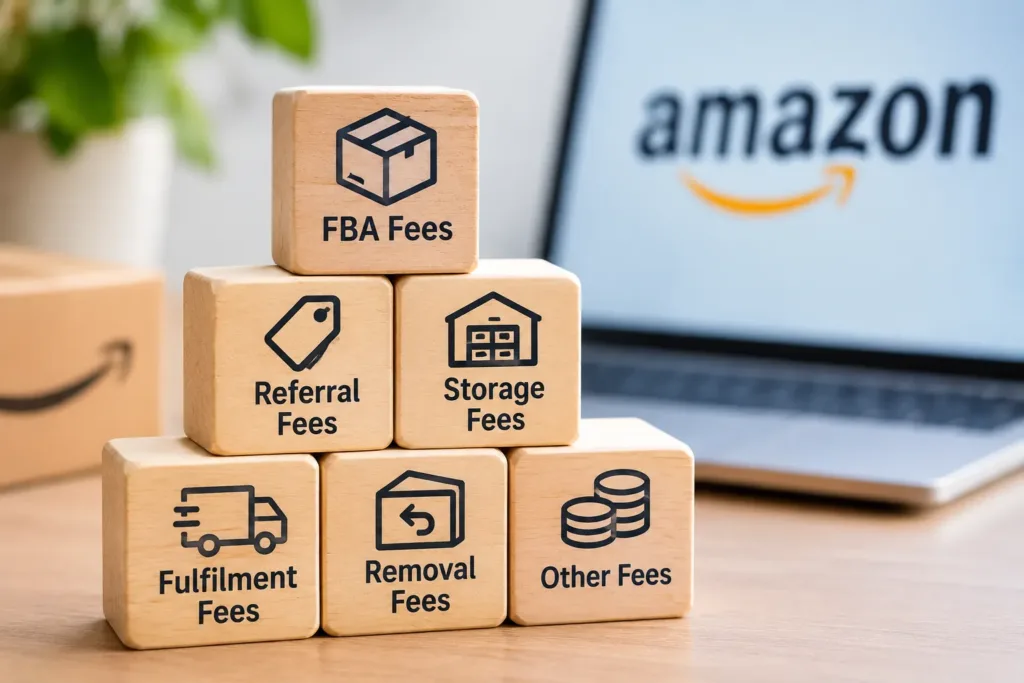
The fees that apply depend on the product and what happens to the inventory while it is in Amazon’s fulfilment network. The main charges to consider include referral, fulfilment and storage fees, along with additional inventory-related charges in certain circumstances.
Referral fees
Amazon charges a referral fee for each item sold. The rate varies by product category and is calculated on the total sales price paid by the buyer, including the item price and any delivery or gift-wrapping charges that apply.
Referral fees are part of the cost of selling through Amazon, but they are not specific to FBA. Sellers should check the current rate for the product category and marketplace in which they plan to sell.
FBA fulfilment fees
Amazon charges an FBA fulfilment fee for each unit it fulfils. The fee covers services such as picking, packing and shipping the order to the customer.
The amount depends on factors including the product’s size and weight. Marketplace and fulfilment arrangements can also affect the rate, which means the same fee should not be assumed across all European Amazon stores.
Amazon may also apply temporary or seasonal adjustments to fulfilment fees. For example, a fuel and logistics-related surcharge currently applies in several European marketplaces, while peak fulfilment fees can apply to certain orders during the festive season.
These adjustments can change, so sellers should use Amazon’s current rates when assessing a product.
Low-Price FBA rates
Amazon applies reduced FBA fulfilment rates to eligible lower-priced products through Low-Price FBA.
Eligibility depends on criteria including selling price, dimensions, weight and category, and the applicable thresholds vary by marketplace.
For products with relatively small margins, checking Low-Price FBA eligibility can make a meaningful difference to the fulfilment cost used in the initial assessment.
FBA storage fees
Amazon charges monthly fees for inventory stored in its fulfilment centres. These fees are based on the space the inventory occupies, using the dimensions of the packaged unit ready for shipment.
Rates can vary according to the type of inventory and the time of year. Amazon distinguishes between storage during January to September and the October to December period, when applicable rates can be higher.
Some sellers may also incur a storage utilisation surcharge, depending on their storage utilisation ratio and the conditions set by Amazon.
Stock turnover consequently affects more than the amount of capital tied up in inventory. Products that remain in FBA for longer continue to generate storage costs.
Aged inventory surcharge
Amazon can charge an additional fee when inventory remains in its fulfilment network for an extended period.
The current aged inventory surcharge can apply to units stored for 181 days or more. Amazon assesses inventory age on the 15th of each month and uses a first-in, first-out basis to determine how long units have been stored.
This charge is separate from the regular monthly storage fee, so slow-moving stock can become more expensive to hold over time.
Removal and disposal fees
Sellers can ask Amazon to return or dispose of inventory stored in its fulfilment centres. Both options can incur a per-unit fee.
The amount depends on factors including the item’s size, weight and the location of the inventory. Cross-border removals can have different rates from local return-to-seller orders.
Other FBA charges sellers may encounter
Additional charges can apply to particular products or services. These may include preparation, inbound transportation and packaging-related costs.
Amazon’s Ships in Product Packaging programme can also affect fulfilment costs for eligible products, while products that require additional Amazon packaging may incur packaging-related fees.
The relevant fee breakdown should therefore be checked for the individual ASIN rather than assuming that every available FBA charge will apply.
How are Amazon FBA fees calculated?
Product size and weight are two of the main factors used to determine FBA fulfilment fees. Amazon places products into defined size and weight tiers and applies the corresponding rate.
The marketplace and fulfilment route can also affect the fee. A unit fulfilled locally may have a different cost from one shipped across borders through the European Fulfilment Network. Our guide to Amazon FBA fulfilment options explains the main fulfilment models available to European sellers.
Accurate product data matters when estimating these costs. If the ASIN, pack size, dimensions or product variation is incorrect, the fee estimate may relate to a different item.
How do Amazon FBA fees vary across European marketplaces?
Amazon does not use one common FBA rate across Europe. Fees vary between marketplaces including Germany, France, Italy, Spain, the Netherlands, Sweden, Poland, Belgium, Ireland and the UK.
The fulfilment programme also affects the amount charged.
With Pan-European FBA, eligible inventory can be distributed across participating EU fulfilment centres so that orders can be fulfilled closer to customers.
The European Fulfilment Network allows inventory stored in one country to fulfil orders placed in other European Amazon stores, with cross-border fulfilment fees applying where relevant.
UK-EU fulfilment is handled separately. Following Brexit, eligible cross-border orders between the UK and EU can be fulfilled through Remote Fulfilment with FBA rather than the former UK-EU EFN arrangement.
Sellers operating in several marketplaces should therefore check the fee for the actual selling market and fulfilment route used.
How to check current Amazon FBA fees
Amazon changes its fee schedules periodically, so current figures should be checked before assessing a product.
The Amazon Revenue Calculator can estimate fees for existing products and products you are considering selling. It can also be used to compare fulfilment methods. The figures it provides are estimates based on the information entered and the applicable Amazon rates.
Seller Central also provides fee information for individual products, while Amazon’s Fee and Economics Preview and Profit Analytics can be used to examine costs associated with FBA inventory.
These tools are preferable to applying a generic fee taken from another product or marketplace, particularly when sourcing for more than one European Amazon store.
Amazon provides fee and revenue estimation tools that sellers can use to check current estimates. Availability and applicable rates should be checked for the marketplace in which the product will be sold.
How do FBA fees affect product profitability?
The difference between a supplier’s price and the Amazon selling price is not the product’s profit. Amazon fees have to be included alongside the purchase price and other costs involved in getting the product ready for sale.
A product can also become less profitable if it remains in FBA longer than expected and accumulates storage costs.
Our guide to assessing product profitability for Amazon FBA explains how to bring these costs together when deciding whether a sourcing opportunity is worth pursuing.
How can inventory decisions affect FBA costs?
The quantity purchased can affect the FBA costs attached to a deal. Excess inventory generates storage costs and, if it remains unsold for long enough, may become subject to the aged inventory surcharge.
Buying a larger quantity to obtain a lower supplier price therefore needs to be considered alongside the product’s expected sales rate and the likely time the stock will spend in FBA.
For more detail on stock levels, replenishment and inventory turnover, read our Amazon FBA inventory management guide.
Frequently asked questions about Amazon FBA fees
How much are Amazon FBA fees?
There is no single rate. FBA fees depend on factors such as product size and weight, marketplace, fulfilment programme and storage requirements. Other charges may apply depending on the product and how the inventory is managed.
What does the Amazon FBA fulfilment fee include?
The fulfilment fee covers Amazon handling the order after a customer buys the product, including picking, packing and shipping. Storage and referral fees are charged separately.
Does Amazon FBA charge storage fees?
Yes. Amazon charges monthly inventory storage fees based on the space inventory occupies in its fulfilment centres. Additional inventory-related charges can apply depending on storage utilisation and how long units remain in FBA.
Are referral fees included in FBA fees?
Referral and FBA fulfilment fees are separate charges. The referral fee is charged when an item is sold, while the FBA fulfilment fee applies when Amazon fulfils the order. An FBA seller can pay both on the same sale.
Are Amazon FBA fees the same across European marketplaces?
No. Rates can vary between European Amazon stores and according to the fulfilment programme used. Sellers should check the applicable fee for the marketplace and fulfilment route in which the product will actually be sold.